
Fire Suppression Equipment Guide
Fire Water Monitor Selection: Manual vs Auto-Tracking (ZDMS)
Fire water monitors — also called water cannons — deliver a concentrated, high-volume water stream at range. They come in two fundamentally different operating philosophies: manual monitors aimed by operators, and auto-tracking monitors that detect, aim and suppress by themselves. Choosing between them is a question of response time, occupancy risk and budget. This guide breaks down the decision.

Manual Fire Water Cannon (PS Series)
High-volume manual monitor for water or foam, 30-70 m range
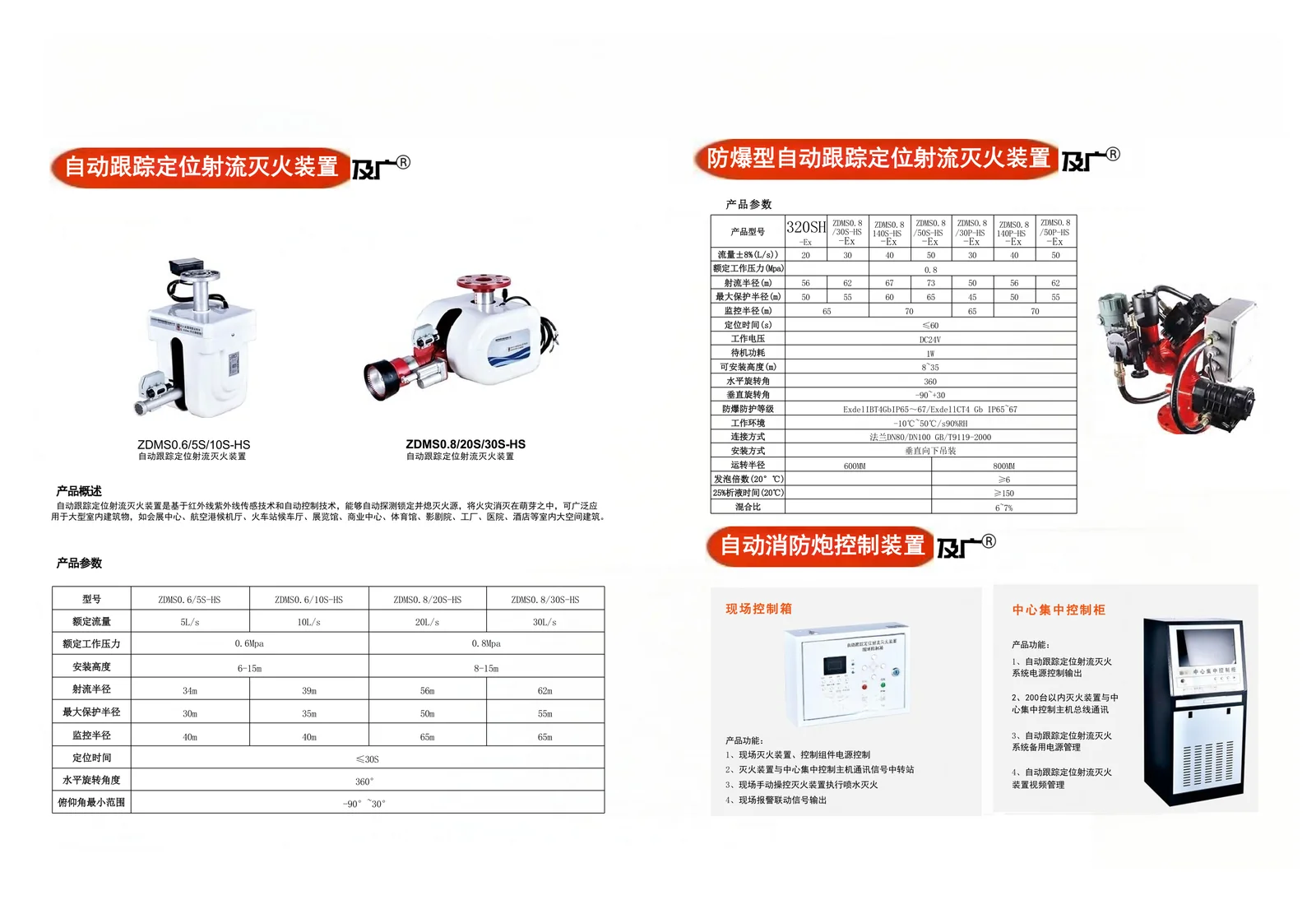
Auto-Tracking Jet Suppression Fire Cannon (ZDMS Series)
IR/UV scanning cannon with autonomous detection and suppression
1. Manual Monitors (PS Series): Operator Control
The PS series manual fire water monitor is the workhorse of industrial firefighting: a fixed turret delivering 20–60 L/s at ranges up to 70 metres, switchable between straight jet and spray, and usable with water or foam. Operation is direct (handwheel or turret) or remotely controlled by an operator watching the scene.
Where it belongs:
- Petrochemical terminals, tank farms and loading racks — foam-capable monitors with fixed protection points.
- Outdoor yards and process areas where operators can safely reach the monitor or a remote control position.
- Cooling and deluge support where directed manual streams supplement automatic systems.
The trade-off is simple: a manual monitor is only as fast as its operator. If nobody can safely reach the control point when a fire starts, it may not be fired at all.
2. Auto-Tracking Monitors (ZDMS): Autonomous Response
The ZDMS auto-tracking jet suppression cannon removes the human from the response loop. Dual-band infrared/UV flame detectors scan the protected space continuously; when a flame signature is confirmed, the cannon swings onto the fire, opens the valve and suppresses it — typically within 30 seconds of ignition, around the clock.
Where it belongs:
- Large indoor spaces with high ceilings — exhibition halls, atriums, warehouses, workshops, hangars.
- Occupancies where a fire can grow faster than personnel can respond.
- Unattended or night-time risk — the system is always watching.
Because ZDMS cannons are sized by coverage zone and ceiling height, the design must map detector fields of view and water density across the whole area. This is why the supplier's engineering support matters as much as the hardware.
3. Head-to-Head Comparison
| Criteria | Manual (PS) | Auto-Tracking (ZDMS) |
|---|---|---|
| Response | Depends on operator reach & reaction | Autonomous, typically <30 s from ignition |
| Flow / range | 20–60 L/s, 30–70 m | 20–40 L/s, indoor coverage by zone |
| Detection | None (operator directed) | Dual-band IR/UV scanning |
| Media | Water or foam (switchable) | Water; foam per configuration |
| Typical use | Tank farms, yards, process areas | Atriums, warehouses, halls, workshops |
| Cost | Lower hardware cost | Higher; includes detection & control |
4. Sizing and Installation Essentials
- Hydraulics first — the monitor's flow demand (L/s) and required residual pressure must be confirmed against the pump and pipe network before selection.
- Coverage mapping for ZDMS — detector field of view, ceiling height and water density define cannon count and position; request a layout drawing from the supplier.
- Foam compatibility — for tank farms, confirm the monitor nozzle and proportioning interface for foam service.
- Testing protocol — agree a commissioning test (range and response time) with the supplier in the contract.
Related Guide: The Buying Decision
Deciding between fixed, remote and smart control — and sizing flow and range for your site? Read the Fire Water Cannon Buying Guide.
Frequently Asked Questions
What is the difference between a manual and an auto-tracking fire water monitor? +
A manual fire water monitor (PS series) is aimed and operated by a firefighter on site, either directly at the turret or via a remote handwheel. An auto-tracking monitor (ZDMS series) continuously scans the protected area with infrared/UV flame detectors and automatically swings onto the fire and suppresses it without operator action — critical for large spaces where a fire must be hit within seconds.
Where are auto-tracking fire cannons (ZDMS) required? +
Auto-tracking cannons are typically specified for large indoor spaces with high ceilings where fire detection and response must be automatic: exhibition halls, atriums, warehouses, aircraft hangars and industrial workshops. The ceiling height and floor area determine the number of cannons and their coverage zones.
What is the effective range of a fire water monitor? +
Effective range depends on flow rate and nozzle configuration. Manual PS monitors commonly deliver 20–60 L/s with ranges of 30–70 metres; auto-tracking ZDMS cannons are typically sized at 20–40 L/s for indoor coverage with response times under 30 seconds. Your fire protection design should size the monitor from the required water density and area of coverage.
Can fire water monitors be used with foam? +
Yes. Most PS series monitors support water or foam spray by switching the nozzle setting, which is why they are common in petrochemical terminals and tank farms. If foam service is planned, specify it in your inquiry so the monitor is configured with the correct foam proportioning interface.
Sizing a Monitor System for Your Site?
Send your site type, protected area and ceiling height — our engineers respond with cannon layout and pricing within 12 hours.